

Jewellery is often understood through categories, yet few are as quietly complex as the brooch. Brooches appear simple at first glance, decorative objects attached to clothing, but the history of brooches reveals a continuous dialogue between function and expression.
A brooch once served a direct purpose. It secured garments, holding layers of fabric in place before closures became standardised. Over time, this necessity gradually receded. What remained was not the function itself, but its outline, a form that continues to suggest utility while no longer depending on it.
This shift allowed the brooch to move beyond use alone. It became a surface for design, a space where materials, techniques, and ideas could come together in a concentrated way. What seems modest in scale often carries a surprising level of complexity.
Brooches as an object
Unlike many forms of jewellery, the brooch is not confined to a fixed position on the body. It can be placed high or low, centred or asymmetrical, discreet or prominent. This freedom gives it a particular presence, one that is shaped as much by the wearer as by the object itself.
Its mechanism remains simple, yet its effect is highly variable. A brooch can secure a garment, emphasise a line, or interrupt the surface of fabric with a deliberate gesture. Because of this adaptability, it resists a single interpretation. It exists somewhere between adornment and intervention.
This openness has allowed the brooch to persist across different periods without losing relevance. Rather than being tied to one moment, it continually absorbs new meanings while retaining its essential structure.

Broche au Firmament
The broche au firmament presents an image rather than a structure. Its surface is composed of closely set stones, arranged in such a way that no single element dominates. Instead, light is distributed evenly, creating the impression of a continuous field.
This type of brooch does not rely on contrast or hierarchy. Its effect emerges through repetition and density, where individual stones dissolve into a larger whole. The result is atmospheric rather than directional, suggesting depth without clearly defining it.
There is a sense of stillness in this approach. The brooch does not seek attention through movement or variation, but through quiet intensity. It invites a slower way of looking, where detail reveals itself gradually rather than immediately.

Broche en tremblant
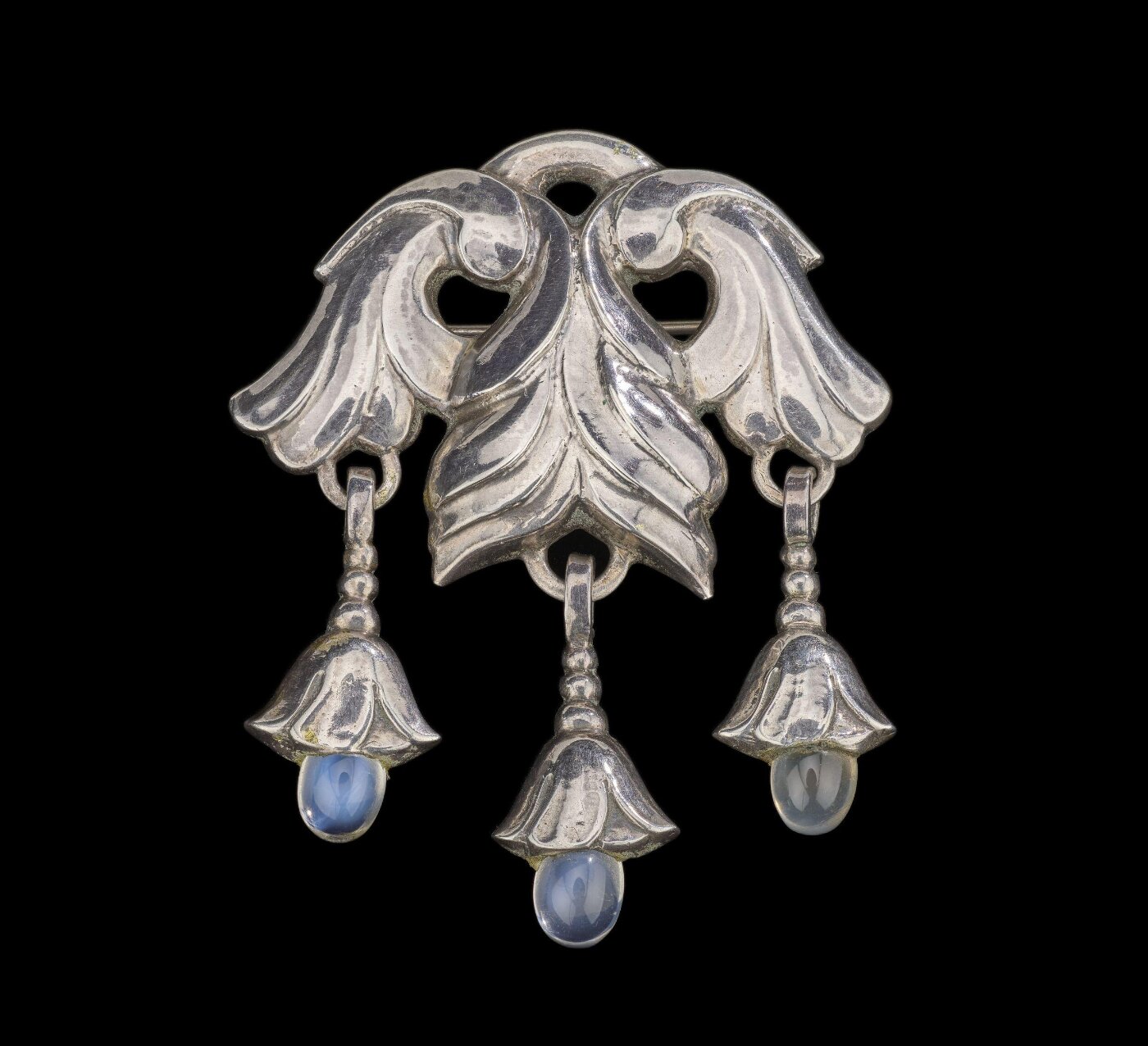
In contrast, the en tremblant introduces movement as a defining element. Small components are mounted on fine springs, allowing them to respond to even the slightest motion. This creates a subtle vibration that changes how light interacts with the surface.
Rather than presenting a fixed image, the brooch remains in a state of quiet transformation. Each shift of the body alters its appearance, however slightly. Light is no longer stable, but dispersed and refracted in continuous variation.
This technique reflects a different understanding of jewellery. It is not only something to be seen, but something that unfolds over time. The brooch becomes responsive, existing in relation to movement rather than apart from it.


The bow brooch
The bow brooch translates the language of textiles into metal. Its form is derived from ribbons, shaped into loops and folds that suggest softness, yet rendered in materials that resist it.
This creates a tension between what is implied and what is present. The bow appears flexible, as if it could be adjusted or undone, but remains fixed in place. It captures a gesture that would normally be temporary and holds it still.
Its associations are subtle but persistent. The bow carries references to dress, to decoration, to moments of arrangement and care. When transformed into jewellery, these associations remain, though they are expressed through structure rather than fabric.

The lapel pin
More restrained in scale, the lapel pin occupies a quieter position within the category. Also referred to as jabot pin or sûreté pin, i is smaller, often more precise, and closely aligned with contemporary forms of dress.
Worn on the lapel of a jacket, it sits near the edge of visibility. It does not dominate, yet it is rarely accidental. Its presence suggests intention, whether personal, professional, or symbolic.
Unlike larger brooches, which may invite prolonged attention, the lapel pin communicates more directly. Its meaning is often understood quickly, yet it can still carry nuance. In its restraint, it demonstrates how little is required to create emphasis.
Brooches: material and meaning
Across these variations, the brooch remains closely tied to the act of placement. It does not exist independently of the body, but gains significance through where and how it is worn.
A shift in position can alter its effect entirely. What appears formal in one context may feel unexpected in another. The brooch interacts with fabric, with movement, and with the surrounding composition of dress.
Materials further shape this relationship. Stones reflect and disperse light, metal defines structure, enamel introduces colour and surface. Each element contributes to how the brooch is perceived, not in isolation, but as part of a larger whole.
In this way, the brooch becomes less a fixed object and more a point of interaction. It connects material, body, and intention in a single, concentrated form.
A continuing form
The brooch resists a singular definition. It can be still or dynamic, subtle or pronounced, structured or atmospheric.
From the quiet surface of the broche au firmament to the responsive movement of the broche en tremblant, from the translated softness of the bow to the precision of the lapel pin, each variation reflects a different approach to jewellery.
What connects them is not only their shared mechanism, but their openness. The brooch does not prescribe how it should be worn or understood. It allows for adjustment, interpretation, and change.
In that sense, it remains one of the most flexible forms of jewellery. Not because it has lost its purpose, but because it has expanded beyond it.

Leave a Reply