
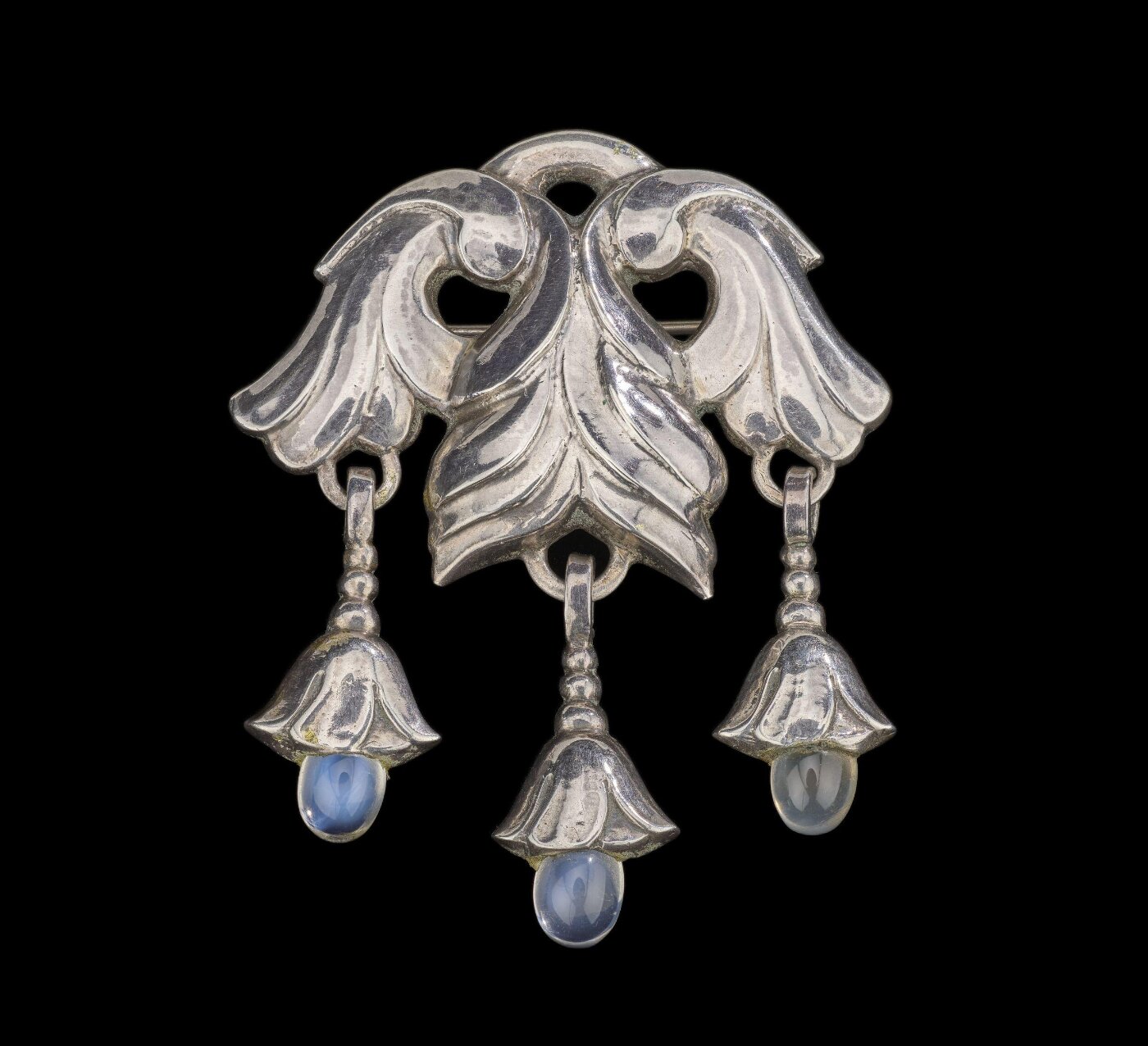
The history of Georg Jensen jewellery unfolds gradually, shaped by a careful balance between tradition and renewal. From its foundation in the early twentieth century, the house developed a distinct approach to jewellery, one that values craftsmanship, material, and clarity of form. While its earliest pieces reflect the ideals of the Arts and Crafts movement, later designers expanded this language, allowing it to evolve without losing its sense of coherence.

Origins in craft and sculpture
Georg Jensen began his career as a sculptor, and this background remained visible in his early jewellery. When he established his workshop in Copenhagen in 1904, he chose silver as his primary material, not out of convention, but because it allowed for a more nuanced expression.
The early pieces show a strong connection to the Arts and Crafts movement. Rather than following the highly polished and decorative style that dominated jewellery at the time, Jensen focused on organic forms and visible craftsmanship. Motifs such as leaves and berries emerge naturally from the surface, while stones like moonstone and amber introduce softness and depth.

The early collaborators
From the beginning, Georg Jensen worked closely with other designers who helped shape the identity of the house. Johan Rohde played an important role by introducing a more structured design language, where ornament and restraint exist in careful balance. His work often feels more composed, yet remains grounded in the same principles of craftsmanship.
Harald Nielsen contributed a sense of refinement and clarity. His designs rely on proportion and precision rather than surface detail, guiding the workshop towards a more modern expression during the early decades of the twentieth century. His work often extended beyond jewellery into silver objects.
Another significant figure was Arno Malinowski, whose work introduced a subtle shift in tone. His designs often draw from natural and animal forms, yet they appear more stylised and expressive. Birds, fish, and other motifs become more dynamic, reflecting a growing interest in movement and character within the jewellery.
Together, these designers ensured that Georg Jensen developed as a collaborative environment rather than a single vision. Each contributed a distinct perspective, while maintaining a shared respect for material and making.

Between tradition and modernity
As the twentieth century progressed, the visual language of Georg Jensen began to shift. The early influence of the Arts and Crafts movement remained visible, yet it gradually gave way to a more streamlined and modern aesthetic. Ornament became less pronounced, and forms moved towards greater simplicity.
This transition did not reject the past, but built upon it. The emphasis on craftsmanship continued to guide the work, even as the designs became more abstract. Jewellery retained a tactile quality, where each element serves a clear and considered purpose.
A new generation of designers
The mid twentieth century introduced designers who redefined the direction of Georg Jensen while remaining connected to its origins. Vivianna Torun Bülow-Hübe brought a radical sense of simplicity, removing all unnecessary elements and allowing form to follow the movement of the body. Her jewellery feels intuitive and fluid, often designed to be worn without closures or constraints.
Nanna Ditzel approached jewellery with a more experimental mindset. Her work explores structure and interaction, challenging traditional expectations of how jewellery should function. Pieces often respond to movement, creating a dynamic relationship between object and wearer.
These designers did not move away from the identity of Georg Jensen, but extended it. They demonstrated that the original principles could support new ideas and different forms of expression.

Material, form, and continuity
Throughout its history, Georg Jensen has maintained a consistent focus on material. Silver remains central, not as a limitation, but as a deliberate choice that allows for softness and variation. This continuity creates a strong visual identity, even as styles evolve.
At the same time, the approach to form has shifted from organic motifs towards more abstract compositions. Despite these changes, the jewellery retains a sense of balance and clarity. Each piece feels resolved, without excess or distraction.
The value of Georg Jensen jewellery
The significance of Georg Jensen jewellery can be understood through three interconnected aspects:
Design: A visual language shaped by balance between tradition and renewal, moving from organic, Arts and Crafts-inspired forms towards increasing abstraction and clarity.
Technique: A continuous emphasis on craftsmanship in silver, where material handling remains central to both early and later designs.
Artistic role: A collaborative design environment in which multiple designers contributed to a shared identity, allowing the house to evolve while maintaining coherence.
Together, these elements position Georg Jensen as a rare example of continuity in twentieth-century jewellery, where stylistic change is absorbed into an enduring design philosophy rather than replacing it.
Looking at the whole
To understand Georg Jensen jewellery, it helps to see it as a sequence rather than a single moment. The early Arts and Crafts inspired pieces establish a foundation of honesty and craftsmanship. Later designers build upon this base, introducing new ideas while respecting what came before.
The result is not a fixed style, but a living language. It adapts, yet remains coherent. It reflects both its origins and its evolution.
In this way, Georg Jensen offers more than individual objects. It presents a way of thinking about jewellery, where material, form, and purpose remain closely connected, and where change does not erase the past, but gives it new meaning.


Leave a Reply