

Few artistic movements transformed jewellery as fundamentally as Art Nouveau. Emerging at the end of the nineteenth century, the movement marked a decisive shift away from traditional ideas of luxury, symmetry and ornamentation. In Art Nouveau jewellery, value was no longer defined solely by the rarity of materials or the precision of setting. Instead, jewellery became a medium for artistic expression.
Art Nouveau changed jewellery by redefining what jewellery could communicate. Through asymmetry, symbolism, technical experimentation, and an emphasis on artistic vision, it introduced a new relationship between design and meaning.
Its influence remains one of the most significant turning points in the history of jewellery.

A break from convention
Before Art Nouveau, much nineteenth-century jewellery was defined by historical revival styles and the display of precious materials. Technical refinement and gemstone value often took precedence over conceptual innovation.
Art Nouveau challenged these priorities.
Rather than repeating established decorative vocabularies, designers sought new forms inspired by movement, nature, mythology, and transformation. Their work rejected rigid symmetry and conventional hierarchies of value.
An object could derive significance from its composition rather than its gemstone weight.
This represented a profound conceptual shift. Jewellery became less about accumulation and more about expression.

The rise of the artist-jeweller
One of Art Nouveau’s most important contributions was the emergence of the jeweller as artist.
Designers such as René Lalique, Philippe Wolfers, and Georges Fouquet approached jewellery as a complete artistic discipline rather than a decorative trade. Their pieces were conceived as unified compositions in which line, colour, material, and symbolism worked together.
This reflected broader developments across the decorative arts, where architecture, furniture, glass, and graphic design were increasingly understood as interconnected creative practices.
Jewellery became part of a larger artistic vision.
As explored in earlier essays on Philippe Wolfers and symbolism in jewellery, this transformation allowed jewellery to move beyond adornment into the realm of artistic interpretation.

A new language of form
Art Nouveau introduced a radically different visual vocabulary.
Curvilinear lines replaced rigid geometric structures. Organic asymmetry replaced balanced repetition. Forms appeared to grow, unfold, and transform.
Natural motifs became central, but they were rarely treated as literal reproductions.
Flowers dissolved into abstraction. Insects became symbols of metamorphosis. Female forms merged with vegetal and animal structures.
This was not naturalism in a scientific sense. It was nature translated into atmosphere.
The resulting objects often feel animated, as though they are still in the process of becoming.
Material innovation
Art Nouveau also expanded jewellery through technical experimentation.
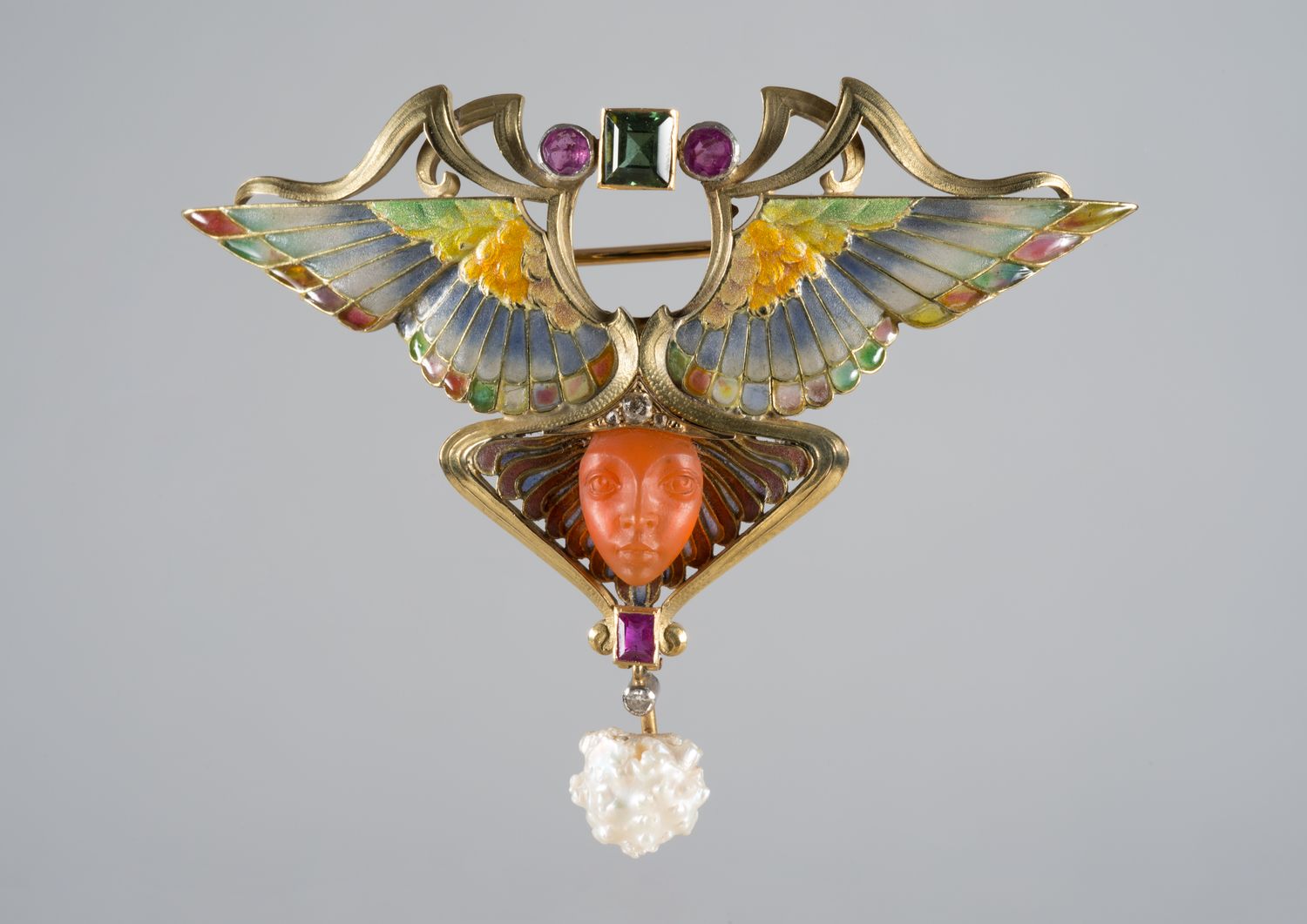
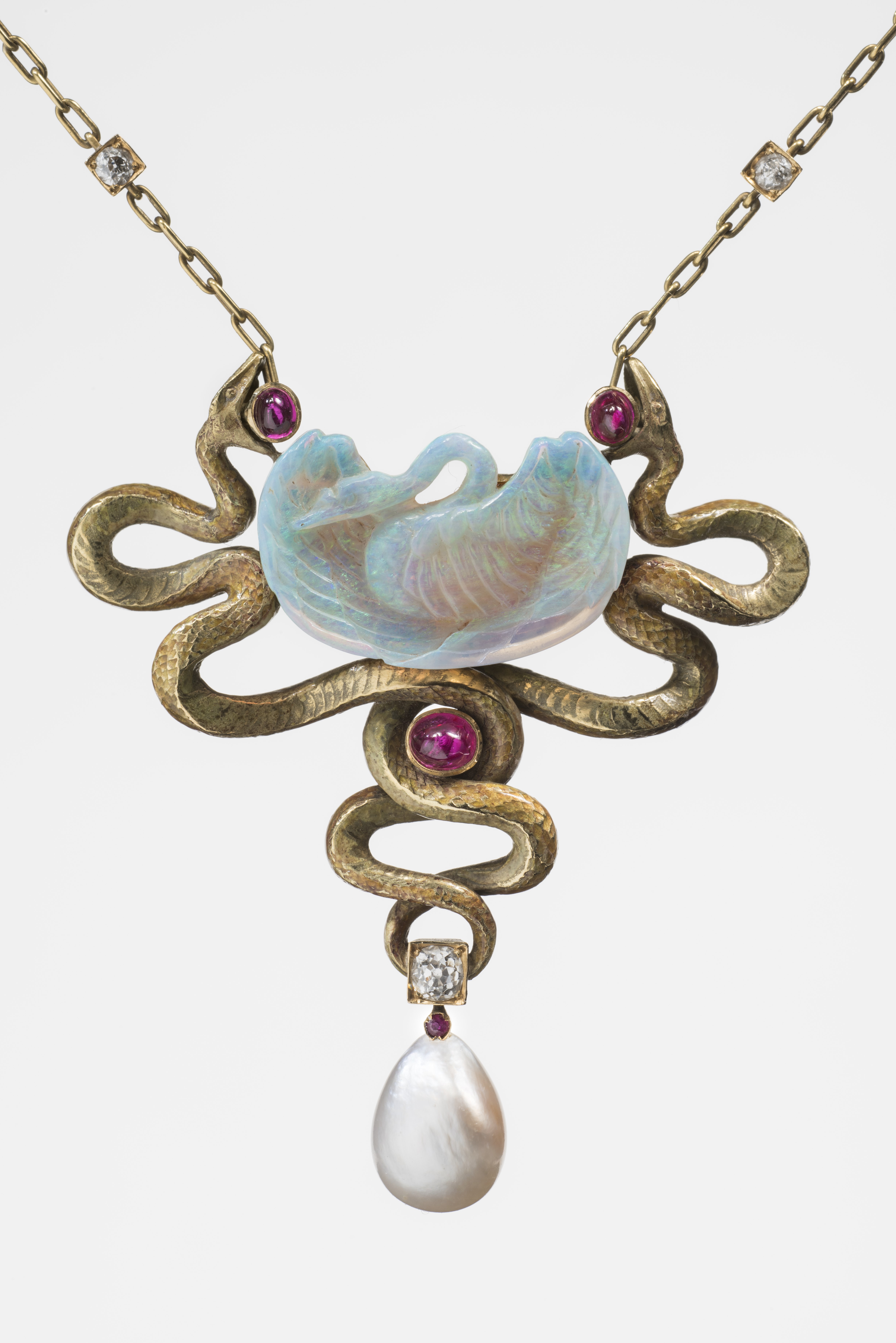
Materials once considered secondary could take on central importance when used for expressive effect. Horn, ivory, enamel, opal, moonstone and glass were employed alongside diamonds and gold, not as substitutes, but as artistic choices in their own right.
Lalique’s transition into glass, seen in works such as Gourdes (1914), demonstrated that Art Nouveau’s most enduring innovation was never tied solely to precious materials, but to atmosphere, experimentation and form.
Plique-à-jour enamel became particularly significant. Its translucent quality allowed light to pass through colour, creating effects reminiscent of stained glass and transforming jewellery into something luminous and almost immaterial.
The value of a piece increasingly lay in artistic execution rather than material hierarchy alone.
This remains one of Art Nouveau’s most radical and enduring legacies.

Jewellery as atmosphere
Perhaps Art Nouveau’s greatest innovation was its ability to create atmosphere.
Rather than simply presenting an object to be admired, Art Nouveau jewellery creates emotional and psychological resonance.
Its forms often evoke ambiguity. They suggest movement without requiring motion, symbolism without explicit explanation, and beauty tinged with tension or mystery.
This complexity gives the best Art Nouveau jewellery an almost literary quality.
Like poetry, it communicates through suggestion rather than direct statement.
Why it still matters
Art Nouveau changed jewellery because it expanded the possibilities of the discipline itself.
It demonstrated that jewellery could carry intellectual, emotional, and symbolic depth while remaining wearable.
Many of the questions contemporary jewellery continues to explore — material experimentation, conceptual meaning, artistic authorship, and formal abstraction — were articulated with extraordinary clarity during this period.
More than a decorative style, Art Nouveau remains a reminder that jewellery can be an art of ideas.
Its lasting significance lies not only in its beauty, but in the way it reimagined what adornment could become.

Leave a Reply