
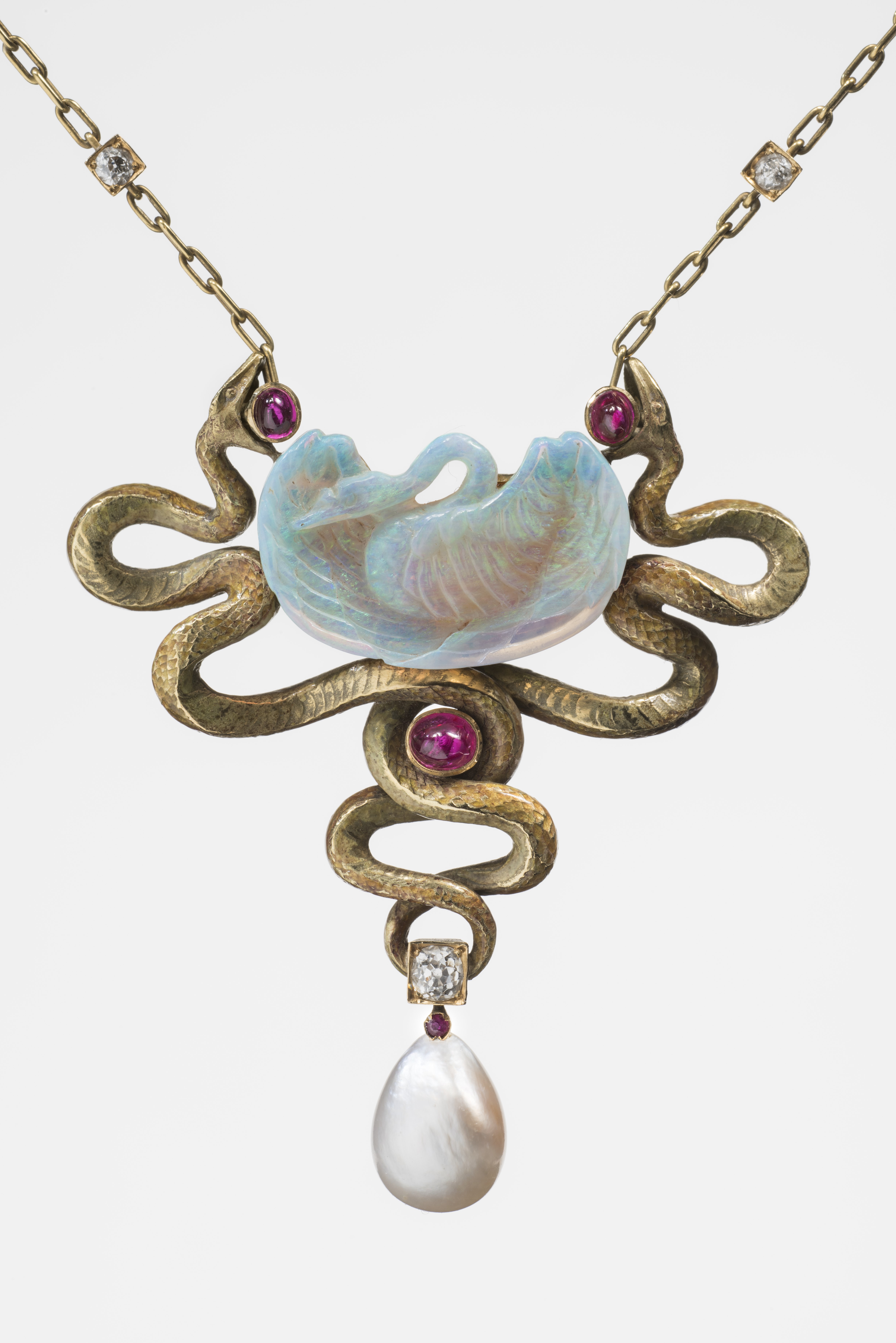
Working within the Belgian maison Wolfers Frères, Philippe Wolfers developed one of the most distinctive visual languages of Art Nouveau jewellery. While many designers of the period embraced natural forms and symbolic imagery, Wolfers approached jewellery with an unusually sculptural sensibility. His objects often appear less like decorative ornaments than miniature works of symbolic design, constructed through the interaction of material, line, and movement.
At the turn of the twentieth century, Wolfers transformed jewellery into something that moved beyond adornment alone. His work reflects the broader ambitions of Art Nouveau, yet retains a striking individuality. Rather than relying solely on ornament, his pieces create atmosphere through composition, asymmetry, and material tension.
Wolfers did not simply decorate surfaces. He constructed objects that appear alive.

Jewellery and sculpture
One of the defining qualities of Wolfers’ work is its relationship to sculpture. His jewellery often extends outward into space, creating silhouettes that feel dynamic and asymmetrical.
Hair ornaments, pendants, and brooches are composed through elongated lines, curving forms, and carefully balanced movement. Rather than framing gemstones conventionally, Wolfers frequently integrated stones into larger compositions where metalwork itself became expressive.
This approach reflects a broader shift within Art Nouveau jewellery. Precious materials remained important, but value increasingly emerged through artistic conception rather than through gemstones alone.
In Wolfers’ work, enamel, horn, ivory, and opal often contribute as much visual significance as diamonds or precious stones. Materials are selected for atmosphere, colour, and texture, allowing jewellery to function as a unified artistic object.

Nature transformed
Natural forms appear constantly throughout Wolfers’ jewellery, yet they are rarely represented literally. Flowers, insects, birds, and aquatic motifs become stylised and elongated, transformed into flowing structures that move between realism and abstraction.
Dragonflies, swans, orchids, and iris flowers recur throughout his work. These motifs reflect Art Nouveau’s fascination with organic growth and fluidity, but Wolfers avoids simple imitation of nature. Instead, natural forms become vehicles for rhythm and movement.
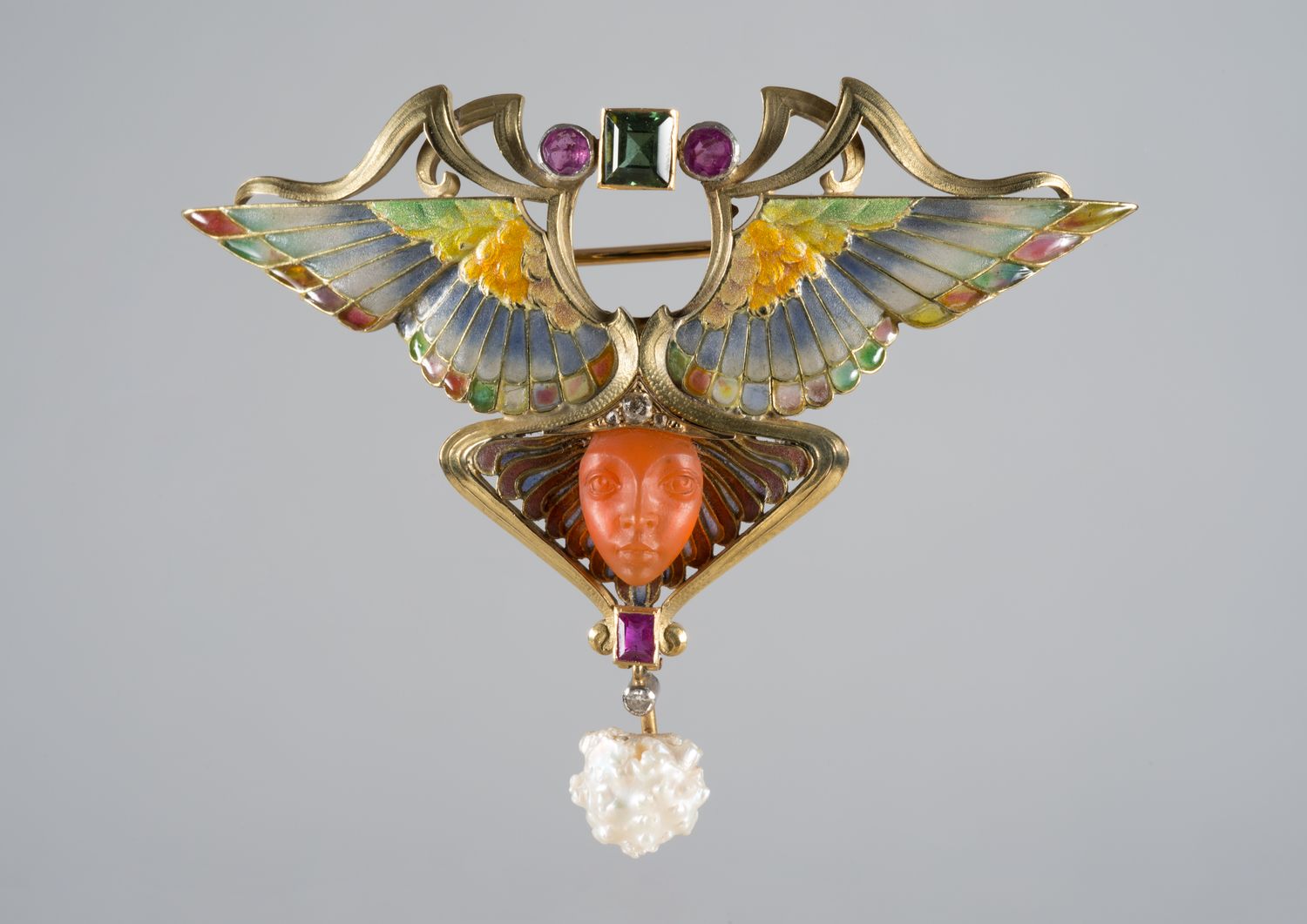
His jewellery often suggests transformation rather than stability. Wings dissolve into lines of enamel, stems extend into asymmetrical compositions, and bodies appear suspended between ornament and living form.
This ambiguity contributes to the distinctive atmosphere of his work. Objects feel animated without becoming entirely representational.
_02.jpg)
Material and colour
Wolfers understood colour as structural rather than merely decorative. Opals, moonstones, enamel, and plique-à-jour surfaces create shifting visual effects that change with light and movement.
Unlike the controlled geometry later associated with Art Deco jewellery, Wolfers’ compositions depend on transition and instability. Colours fade gradually into one another, surfaces appear translucent, and outlines remain deliberately fluid.
Plique-à-jour enamel is particularly important within this language. Because light passes through the enamel rather than reflecting from an opaque surface, objects acquire an almost stained-glass quality. This creates a sense of fragility and luminosity that reinforces the dreamlike atmosphere associated with Art Nouveau.
The technical complexity required to achieve these effects reflects Wolfers’ exceptional craftsmanship. His objects are intricate without appearing rigid, maintaining a sense of natural growth despite their precision.
.jpg)
Jewellery as total artwork
Wolfers worked during a period in which decorative arts increasingly aspired toward artistic unity. His jewellery reflects this ambition through its integration of symbolism, material, and form.
Many pieces resist clear separation between object and image. A brooch may simultaneously function as jewellery, sculpture, and symbolic composition. This overlap aligns closely with the broader Art Nouveau ideal of the Gesamtkunstwerk, or total artwork, in which decorative objects become part of a unified artistic environment.
Wolfers’ work also demonstrates how jewellery can communicate mood rather than narrative. His pieces rarely illustrate specific stories directly. Instead, they evoke atmosphere through movement, texture, and visual tension.
Collecting Philippe Wolfers jewellery today
Collectors continue to value Wolfers for the singularity of his design language. His jewellery occupies a position between decorative art and sculpture, appealing not only to jewellery collectors, but also to audiences interested in Symbolism, Art Nouveau, and fin-de-siècle design more broadly.
Original pieces remain relatively rare, particularly those that preserve delicate enamelwork and complex sculptural elements. Because many designs rely on subtle material effects, condition plays a significant role in how the objects are experienced.
Wolfers’ jewellery also retains a striking contemporary quality. Despite being rooted in the visual culture of the late nineteenth century, many pieces continue to feel experimental and psychologically charged.
Their appeal lies not only in craftsmanship, but in their ability to blur boundaries between ornament, nature, and sculpture.
Objects in transformation
Philippe Wolfers approached jewellery as a living form rather than a static object. His pieces resist strict symmetry and fixed interpretation, unfolding through light, movement, and material interaction.
This sense of transformation remains central to their enduring fascination. Jewellery becomes more than adornment; it becomes atmosphere made material.
Wolfers’ work demonstrates how Art Nouveau jewellery could move beyond decoration alone, creating objects that remain visually unstable, emotionally charged, and unmistakably alive.


Leave a Reply