
Jewellery is often approached as an object of adornment, yet in certain moments in history it becomes something more deliberate. At the turn of the twentieth century, a small group of jewellers began to move away from convention, seeking new forms of expression that aligned more closely with the artistic movements of their time. Among them, Georges Fouquet occupies a distinctive position.
His work reflects a shift in how jewellery could be understood: not only as a display of materials, but as a carefully composed work of art.

A maison in transition
The Fouquet jewellery house was founded in the nineteenth century by Georges Fouquet’s father, Alphonse Fouquet. When Georges took over in 1895, he inherited both a respected Parisian atelier and a traditional approach to jewellery-making.
Rather than continuing along established lines, he chose to reposition the house within a more progressive artistic context. This decision coincided with the rise of Art Nouveau, a movement that sought to dissolve boundaries between fine and applied arts.
Moreover, this shift also brought new forms of collaboration. Designs associated with Alphonse Mucha introduced a more graphic and ornamental language, aligning the house with contemporary developments in the decorative arts.

Jewellery as composition
Fouquet’s jewellery is characterised by a strong sense of composition. Rather than centring value on gemstones alone, he treated each piece as a balanced arrangement of line, colour, and form.
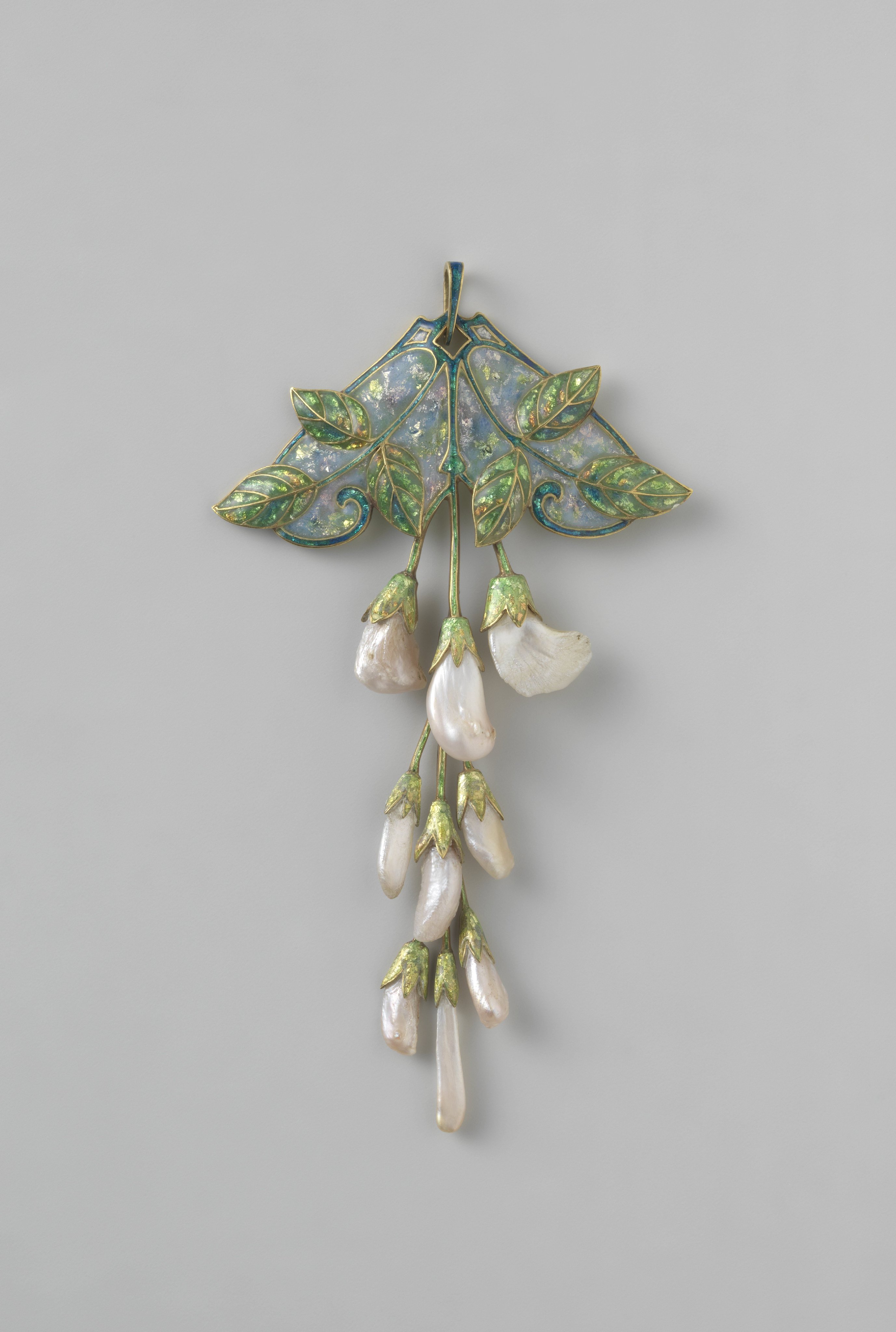
This approach is clearly visible in the wisteria pendant, where cascading enamel forms evoke the natural rhythm of the plant. The piece is not symmetrical, nor is it structured around a single focal stone. Instead, it unfolds gradually, guiding the eye through its composition.
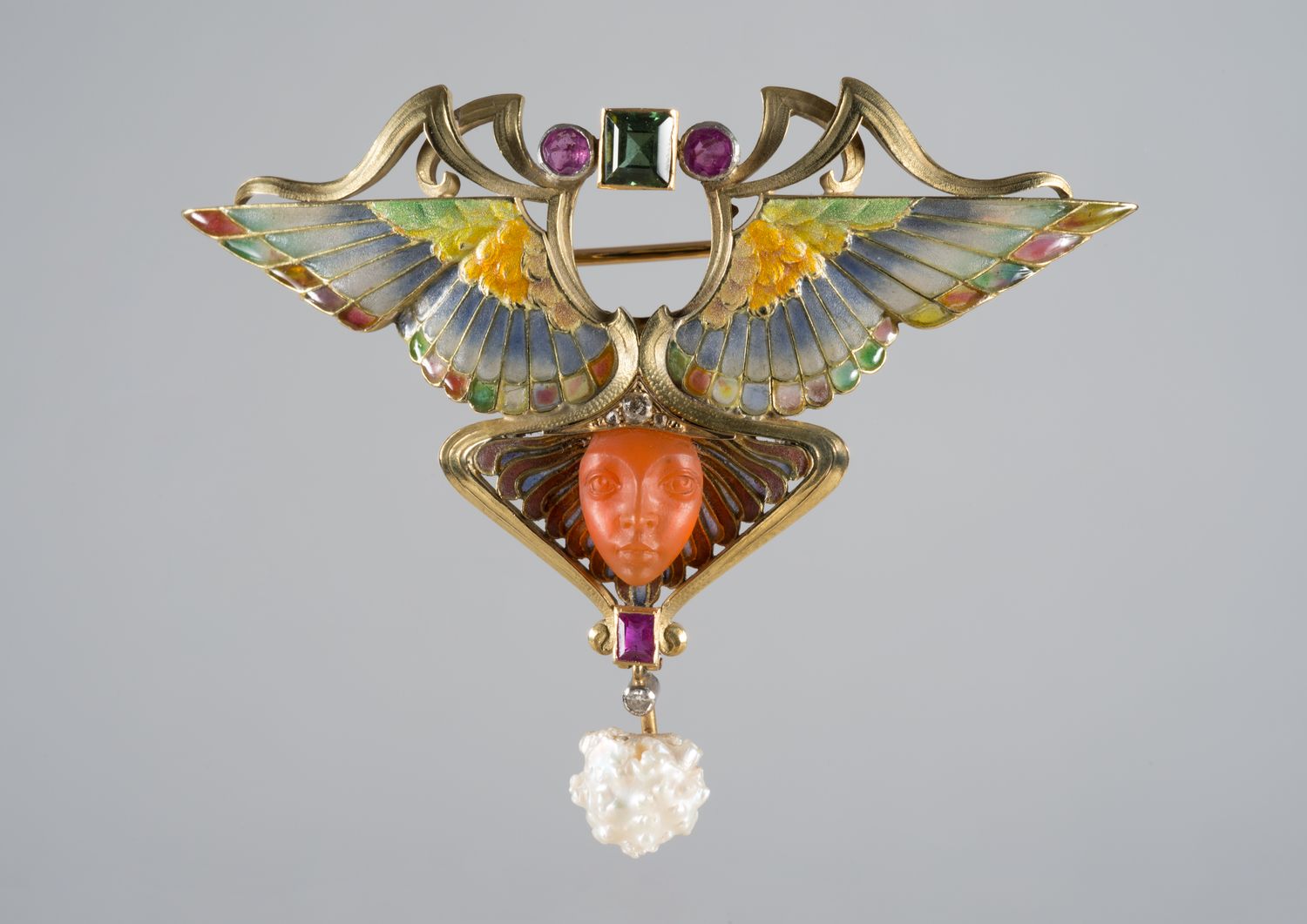
Similar principles appear in the brooch-pendant, where enamel, gold, and gemstones are integrated into a unified design. Materials are not layered hierarchically but interact with one another, creating a sense of depth without relying on traditional settings.

Nature, transformed
Nature plays a central role in Fouquet’s work, yet it is rarely represented literally. Instead, natural forms are stylised and abstracted.
In the selected brooch, organic lines define the overall structure, while colour is used to suggest rather than replicate natural elements. This transformation reflects a broader Art Nouveau interest in movement and fluidity, where form is prioritised over strict realism.
The result is jewellery that feels dynamic rather than static. Lines extend, curve, and return, creating a sense of motion within a fixed object.

The role of materials
Fouquet’s use of materials reinforces his artistic approach. Enamel plays a particularly important role, allowing for subtle gradations of colour that would be difficult to achieve with gemstones alone.
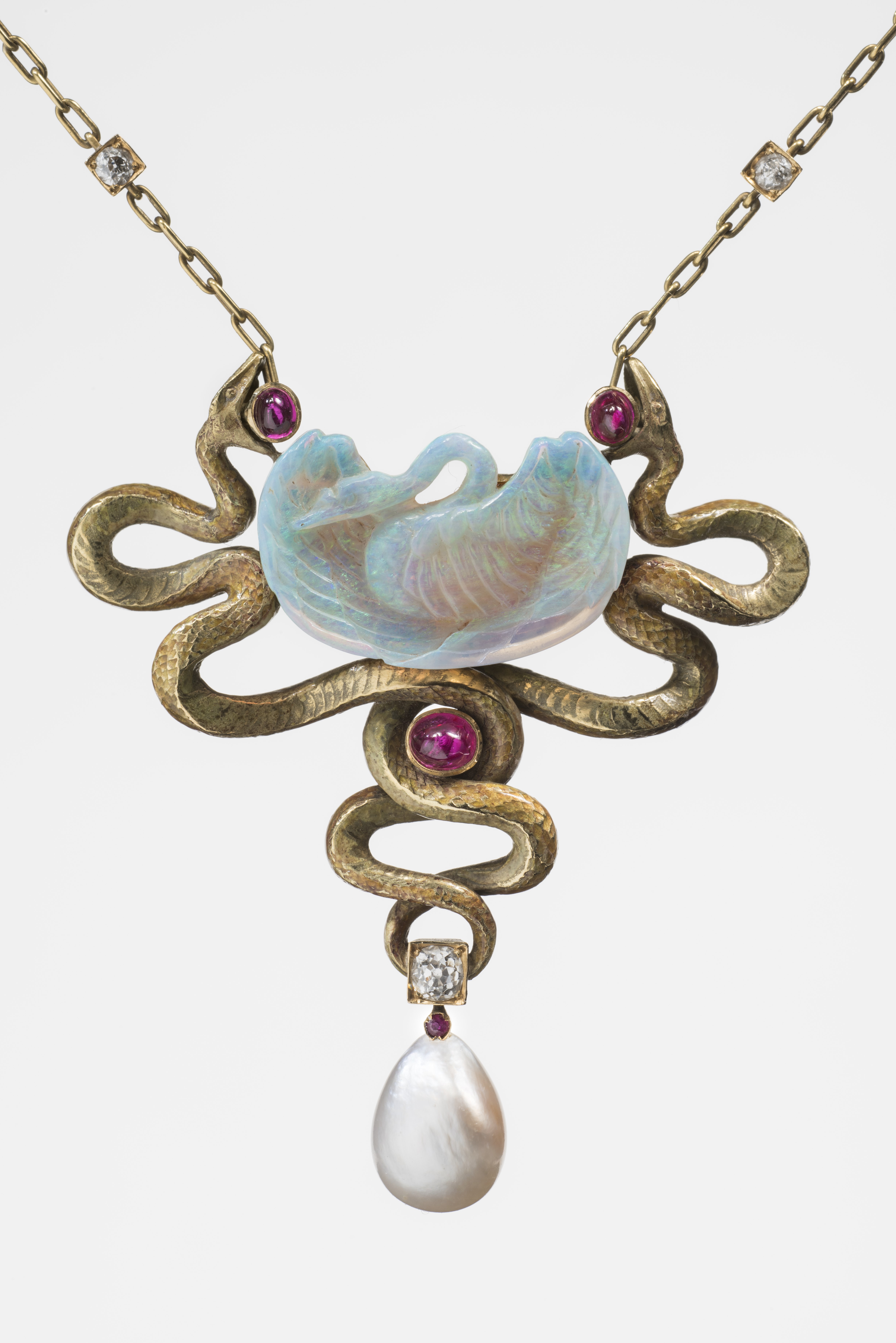
Opals, moonstones, and other less conventional stones are often favoured over diamonds, not for their rarity, but for their visual qualities. Transparency, iridescence, and colour variation become part of the composition.
Gold, rather than serving purely as a structural element, is shaped into flowing lines that contribute directly to the design.
An integrated presentation
The interior of the Fouquet boutique demonstrates how these ideas extended beyond individual objects. Rather than presenting jewellery within a neutral setting, the environment echoed the same formal principles: rhythm, ornament, and continuity of line.
In this context, jewellery was not isolated but positioned within a carefully considered visual framework. The setting reinforced how each piece functioned: as part of a broader approach in which design, display, and perception were closely connected.

Georges Fouquet and René Lalique
Fouquet’s work is often considered alongside that of René Lalique, whose influence on Art Nouveau jewellery was equally significant. While both designers moved away from traditional hierarchies of value and embraced enamel and unconventional materials, their approaches differ in emphasis.
Lalique’s work frequently centres on symbolism and narrative, with figures, faces, and mythological references playing a prominent role. Fouquet, by contrast, tends toward a more structural interpretation. His pieces are less concerned with storytelling and more focused on composition, rhythm, and the interaction of forms.
The value of design in Georges Fouquet jewellery
The significance of Georges Fouquet jewellery can be understood through three interconnected aspects:
Design: A compositional approach defined by asymmetry, flowing line, and the balanced organisation of form rather than a central focal point.
Technique: The integration of enamel, gold, and gemstones as equal elements, allowing colour and material to function as part of the overall composition.
Artistic role: A contribution to Art Nouveau in which jewellery is positioned as a form of design, closely connected to broader developments in the decorative arts.
Together, these elements place Fouquet within a distinct position in the development of Art Nouveau jewellery, where structure and composition take precedence over narrative or symbolism, in contrast to contemporaries such as René Lalique.
Position and significance
Fouquet’s jewellery reflects a moment in which established conventions were reconsidered. By shifting attention from the prominence of individual materials to the organisation of form, his work aligns closely with the broader aims of Art Nouveau.
Within this context, his pieces can be understood not simply as decorative objects, but as part of a wider exploration of how jewellery could function: as composition, as design, and as an integral element within a larger visual culture.


Leave a Reply