

Cartier is often regarded as one of the most influential names in jewellery. The significance of Cartier lies not only in its history or clientele, but in the way it has consistently shaped how jewellery is designed, worn, and understood.
Known for its distinctive approach to form, line, and composition, the house occupies a central position within the development of modern jewellery.
The history of Cartier
Founded in Paris in 1847 by Louis-François Cartier, Cartier began as a small workshop before gradually establishing itself among the leading jewellers of the French capital.
The house was later developed by his son Alfred Cartier, and subsequently by Alfred’s three sons: Louis, Pierre, and Jacques Cartier. Each played a distinct role in shaping the maison’s international presence. Louis Cartier remained in Paris, overseeing design and creative direction, while Pierre and Jacques expanded the business abroad, establishing Cartier in New York and London.
By the early twentieth century, Cartier had become one of the first truly international jewellery houses. Its growth coincided with increasing global exchange, both in clientele and in artistic influence.
Within this context, the maison developed a distinctive identity—one that would contribute significantly to the evolution of jewellery design in the modern era.

Cartier and the evolution of jewellery design
At the turn of the twentieth century, jewellery began to move towards greater precision and structural clarity. New materials, particularly platinum, made it possible to achieve a level of precision and refinement that had not previously been possible.
Among the first houses to fully explore its potential, Cartier used platinum to create lighter, more intricate structures. Its strength allowed for delicate settings that emphasised the stones rather than the metal itself. This resulted in compositions defined by line and clarity.
Through this approach, the house contributed to a shift in jewellery design: from weight and ornament towards precision and structure. Rather than simply adopting new materials, Cartier helped establish a new visual language. It redefined not only how jewellery was made, but also how it was worn and experienced.
This broader consideration of use becomes particularly clear in one of the house’s most well-known creations.

The Santos: jewellery and function
In 1904, the aviator Alberto Santos-Dumont approached Louis Cartier with a practical request: a watch that could be read while flying.
So, the result was the Santos, one of the first wristwatches designed for everyday use. By making time visible on the wrist rather than concealed in a pocket, it introduced a new relationship between object and wearer.
This moment illustrates a key aspect of the maison: an attention to context. Jewellery and objects are not only designed to be seen, but to be used.
Alongside this functional awareness, the house also developed a distinct visual identity: one shaped as much by imagination as by structure.
Jeanne Toussaint and the emergence of the panther
If structure defines one aspect of Cartier, imagination defines another.
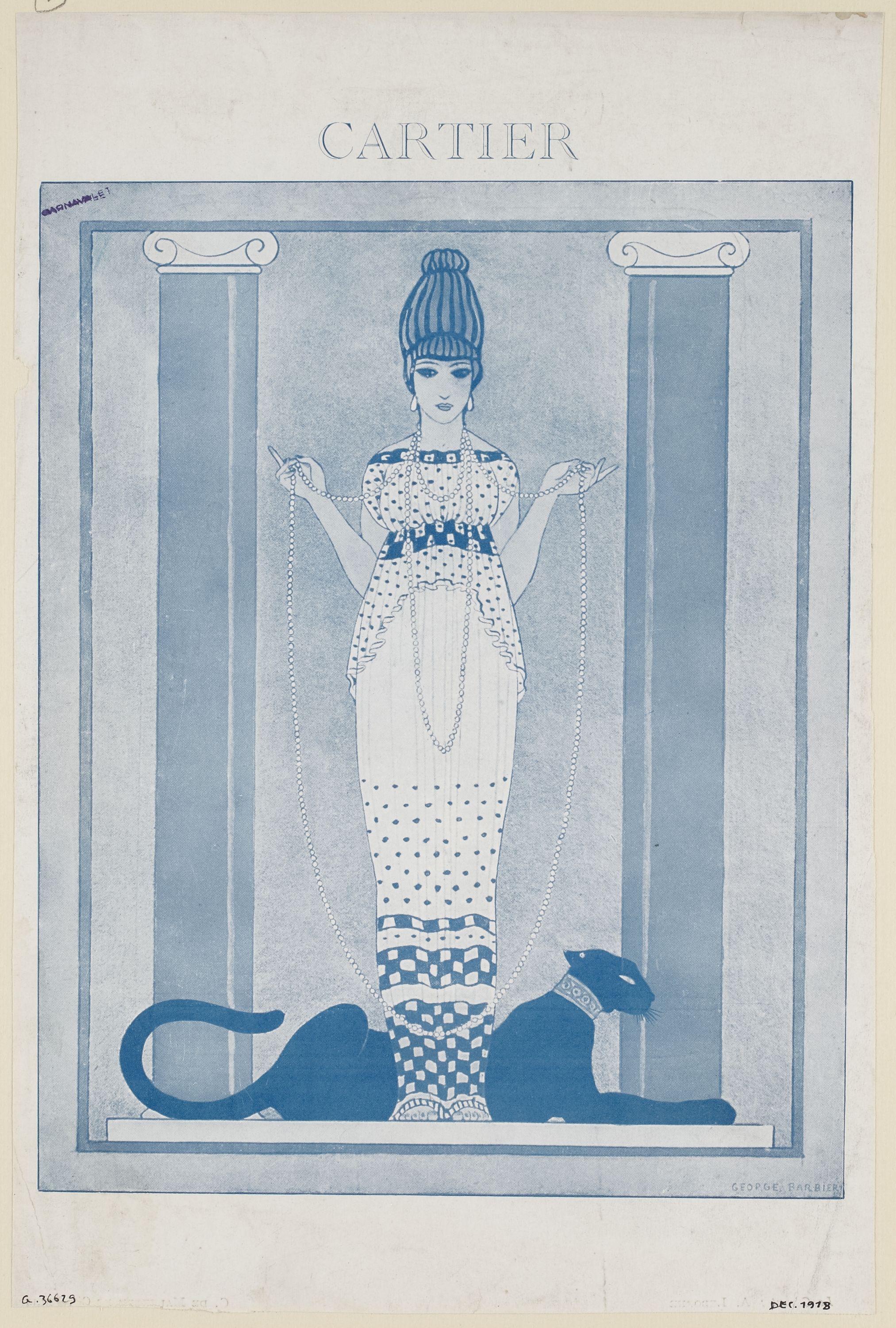
Under the creative direction of Jeanne Toussaint, the house introduced one of its most enduring symbols: the panther.
More than a decorative motif, the panther functions as a presence within Cartier’s work. It combines control with movement, restraint with intensity. Over time, it has become one of the most recognisable expressions of the house’s identity.
The panther represents a figurative and expressive direction. Other creations focus instead on composition and material as primary elements.

Tutti Frutti: a dialogue of influences
Another defining expression of Cartier can be found in the Tutti Frutti jewels.
These pieces combine carved emeralds, rubies, and sapphires in compositions that draw on Indian jewellery traditions while translating them into a distinctly Parisian context.
This exchange of influences reflects a broader characteristic of the house: an ability to absorb and reinterpret external sources without losing coherence.
The value of design at Cartier
The value of Cartier lies in a combination of design, craftsmanship, and historical position.
Design: A consistent visual language, defined by line, proportion, and recognisable forms.
Craftsmanship: Precise execution supported by technical expertise and material knowledge.
Heritage: A long-standing role in shaping the development of modern jewellery.
Together, these factors place Cartier among the most important houses within the field.

Continuity and use at Cartier
Today, Cartier continues to build on its historical foundations. Many of its most recognisable elements, including the panther and early design principles, remain present in contemporary collections.
Rather than being confined to archives or exhibitions, these designs continue to be worn. Their meaning is not fixed, but develops through ongoing use and reinterpretation.
Cartier within a broader jewellery landscape
To understand Cartier is to place it within a wider context of jewellery houses, each contributing in different ways to the field.
Where Cartier is often associated with line, structure, and recognisable forms, other maisons, such as Boucheron, explore alternative approaches to material, surface, and composition.
Together, these perspectives form a more complete understanding of jewellery as a discipline: one shaped by variation as much as by consistency.
Understanding jewellery through Cartier
Cartier offers a way of understanding jewellery through design decisions that unfold over time. Its pieces do not exist in isolation, but are shaped by those who create them and those who wear them.
Seen in this way, the house becomes more than a historical reference. It functions as a reference point through which jewellery can be studied across houses, techniques, and objects.
Meaning does not emerge all at once. It reveals itself gradually, through attention and continued observation.

Leave a Reply