
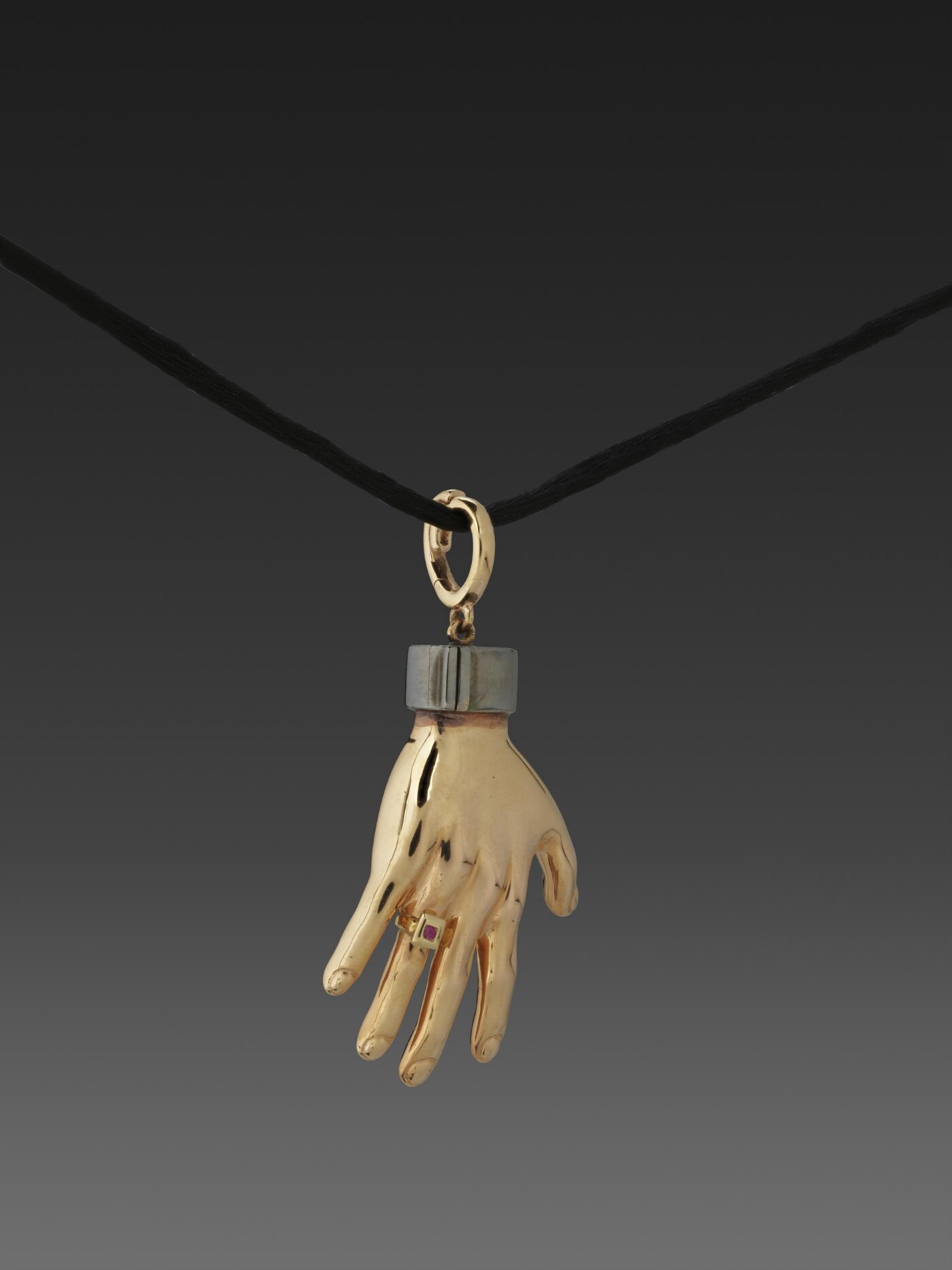
Hands appear throughout the history of jewellery with remarkable consistency. They emerge across centuries, materials, and styles, carrying meanings that shift between devotion, intimacy, protection, and identity. Sometimes realistic, sometimes abstracted, they remain among the most recognisable and emotionally charged motifs in jewellery design.
Unlike many ornamental forms, the hand possesses an immediate human presence. It suggests gesture, touch, and connection. Even when reduced to a simplified outline, it retains a psychological intensity that distinguishes it from purely decorative motifs.
Jewellery featuring hands is rarely neutral. It invites interpretation.

Gesture and symbolism
The symbolic use of hands predates modern jewellery traditions by centuries. Across different cultures, the hand has functioned as a protective emblem, a sign of loyalty, or a representation of spiritual authority.
One of the most enduring examples is the fede ring, in which two clasped hands symbolise trust, fidelity, and union. Originating in ancient traditions and becoming particularly widespread during the medieval and Renaissance periods, fede rings demonstrate how gesture itself can communicate meaning.
The power of the motif lies in its clarity. A hand reaching, holding, or enclosing immediately suggests relationship. Jewellery transforms this gesture into an object carried on the body, allowing symbolism to become physically present.

The hand as form
Beyond symbolism, hands possess a distinct sculptural quality that has repeatedly attracted jewellers and designers.
The structure of the hand — its articulation, proportion, and movement — offers unusual formal possibilities. Fingers can curve around stones, frame objects, or create tension within a composition. Some designs emphasise anatomical realism, while others reduce the hand to a more stylised or architectural form.
This adaptability explains why the motif appears across very different movements and periods. In nineteenth-century jewellery, hands often conveyed sentiment and intimacy. In Art Nouveau, they became elongated and expressive, integrated into flowing compositions. Later interpretations embraced sharper geometry or surreal distortion, transforming the motif into something more ambiguous and psychologically complex.
The hand remains recognisable even when abstracted, allowing designers to move between realism and symbolism without losing clarity.

Jewellery and intimacy
Few motifs create such an immediate sense of proximity. Hands are associated with touch, and touch itself occupies a central role in how jewellery is experienced.
Jewellery exists in direct contact with the body. A motif based on the hand therefore creates a layered relationship between object, wearer, and gesture. Rings depicting clasped hands, for example, transform physical connection into permanent form.
This intimacy may explain why hand motifs continue to feel emotionally charged even in contemporary contexts. They suggest presence in the absence of the body itself.
At times, this can also create tension. Certain hand motifs appear protective or affectionate, while others feel unsettling or uncanny. The ambiguity contributes to their lasting fascination.
Surrealism and reinterpretation
Twentieth-century designers increasingly explored the psychological and symbolic potential of the hand. Surrealist influences encouraged jewellers to treat body fragments not simply as decorative forms, but as independent symbolic objects.
Hands could become fragmented, exaggerated, or displaced. Rather than representing harmony, they sometimes introduced ambiguity or unease.
This shift reflects broader changes in how jewellery was understood. Objects were no longer expected only to decorate the body, but also to provoke reaction and interpretation. The hand, already deeply associated with identity and human presence, became particularly suited to this transformation.
Collecting hand jewellery
Collectors are often drawn to hand motifs because they occupy a space between ornament and narrative. These objects tend to feel personal, even when their original context is unknown.
Their appeal also lies in variety. Hand motifs appear across rings, brooches, pendants, charms, and mourning jewellery, allowing collectors to encounter the theme through very different materials and periods.
Some pieces attract attention through symbolism, while others are valued primarily for their sculptural qualities or unusual design. In many cases, the most compelling examples combine both.
As with other forms of jewellery, collectability is not determined solely by attribution. Proportion, craftsmanship, and the relationship between motif and composition remain essential.

Objects that continue to gesture
Hands in jewellery persist because they communicate something fundamentally human. They transform gesture into form, allowing emotion, protection, intimacy, or tension to become material.
Their meanings remain unstable, shifting between affection and control, realism and abstraction, symbolism and design. This instability is precisely what allows the motif to endure across changing periods and styles.
Even in their smallest forms, these objects continue to suggest presence. They do not merely decorate the body. They imply connection, memory, and touch, preserving gesture long after the moment itself has disappeared.


Leave a Reply