
Jewellery at the turn of the twentieth century did not develop in isolation. It was shaped not only by materials and techniques, but also by a growing awareness of its own history. Within this context, Henri Vever jewellery occupies a distinct position.
Jewellery by Henri Vever reflects a dual approach: that of a maker of objects and a historian of the medium. This combination introduces a level of reflection that sets his work apart within Art Nouveau.
A house and a historical consciousness
The Vever house, founded in 1821, reached its artistic development under the direction of Henri and his brother Paul. While Paul oversaw the business, Henri shaped the artistic identity of the firm.
What distinguishes Henri Vever jewellery is not only its visual language, but the awareness with which it was produced. Alongside his work as a jeweller, Vever authored one of the earliest comprehensive studies on French jewellery, establishing a direct link between practice and historical understanding.
This dual role—maker and historian—forms the foundation of his approach.

Jewellery and the written image
The Revue de la Bijouterie print introduces an essential aspect of Vever’s work. Jewellery here appears not only as an object, but as something recorded, reproduced, and circulated.
Through publications, Henri Vever contributed to the formation of a shared visual language. His work exists both materially and intellectually, positioning jewellery within a broader cultural framework.
This reflects a shift from craftsmanship alone towards a more self-aware artistic practice.

From drawing to object
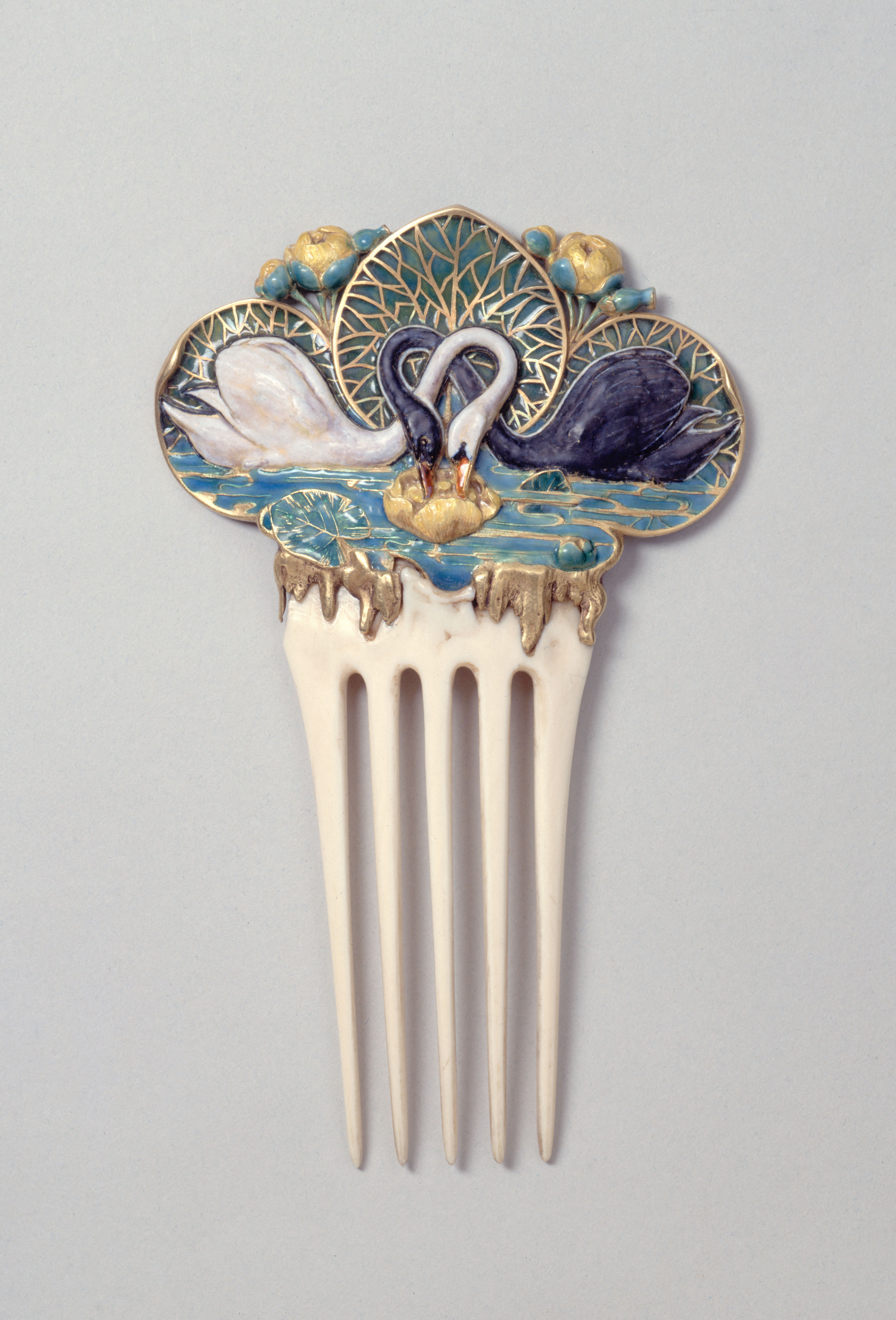
The gouaché for the swan and waterlily comb reveals the design process behind Henri Vever jewellery. Line, colour, and composition are already established, yet remain flexible.
In the finished comb, these elements are translated into material. The curved necks of the swans and the rhythm of the waterlilies define the structure, while enamel and gemstones introduce variation and depth.
This transition from drawing to object demonstrates how design operates as an intermediary stage, where ideas are organised before becoming fixed in material form.

Nature and Structure
A defining characteristic of Henri Vever jewellery is the transformation of natural motifs into structured compositions.
In the swan and waterlily comb, organic forms are recognisable, yet they are not treated as isolated elements. Instead, they are integrated into a continuous arrangement, guided by line and balance.
This approach aligns Vever with Art Nouveau, while also revealing a degree of control that distinguishes his work from more expressive interpretations of nature.
Variation and material
The tiara expands this language into a different register. While maintaining a connection to natural forms, it introduces a more elaborate interplay of materials, including pearls and platinum.
Here, the emphasis shifts towards light and repetition, yet the underlying structure remains consistent. Elements are organised as part of a whole, rather than arranged hierarchically.
This balance between variation and coherence defines the visual identity of the Vever house.

Vever and Lalique
Henri Vever jewellery is often considered alongside that of René Lalique. Both engage with nature, enamel, and innovative materials, yet their approaches differ.
Lalique’s work frequently centres on symbolism and narrative. Vever, by contrast, appears more reflective. His jewellery suggests an awareness of historical precedent, combined with a controlled and structured approach to design.
The value of design in Henri Vever jewellery
The significance of Henri Vever jewellery can be understood through three interconnected aspects:
Design: A structured interpretation of natural forms, where composition and balance take precedence over purely expressive representation.
Technique: The integration of enamel, gemstones, and unconventional materials, combined with a high level of craftsmanship.
Artistic role: A dual position as both jeweller and historian, contributing to the understanding and documentation of jewellery as an artistic discipline.
Together, these elements position Henri Vever jewellery within Art Nouveau as both a creative and reflective practice.
Object, drawing and context
To understand Henri Vever jewellery, it is useful to consider the relationship between object, drawing, and text. Each reveals a different aspect of the same approach.
The published image situates jewellery within a wider discourse. The drawing shows the formation of ideas. The finished object resolves these elements into material form.
Seen together, they suggest that Henri Vever jewellery is not defined by a single piece, but by the connections between them. Jewellery becomes part of a broader system in which making, thinking, and recording are closely intertwined.


Leave a Reply